
About STEVE
Indian music
Steve Gorn’s bansuri is featured on the 2011 Grammy winning recording, “Miho – Journey to the Mountain,” with Dhruba Ghosh and the Paul Winter Consort, as well as the Academy Award winning Documentary film, “Born into Brothels.” He has performed Indian Classical Music and new American Music on the bansuri bamboo flute in concerts and festivals throughout the world. His gurus are the late bansuri master Sri Gour Goswami, of Kolkata, and Pt. Raghunath Seth of Mumbai, who he often accompanied in concert. He also studied with the late Ustad Z. M. Dagar. He has often performed in India, appearing at Bharat Bhavan in Bhopal, Habitat Center and Triveni Hall in New Delhi, The Sangeet Research Academy in Kolkata, NCPA, and The Nehru Center in Mumbai, and numerous other venues. His performance with Pandit Ravi Shankar’s disciple, Barun Kumar Pal, at Kolkata’s Rama Krishna Mission, was televised throughout India. In 2013, he was awarded the Pandit Jasraj Rotary Club of Hyderabad Award for Cross Cultural Achievement.
His numerous recordings include Luminous Ragas, Rasika, (with tabla by Samir Chatterjee,) Illuminations, (with Nepali bansuri wallah, Manose,) the landmark Indian-Jazz fusion recording, Asian Journal, and Pranam, a jugalbandi with Barun Kumar Pal playing hansaveena, and Samir Chatterjee, tabla.
World music
Steve Gorn, whose flute is featured on the 2011 Grammy winning recording, “Miho – Journey to the Mountain,” with the Paul Winter Consort, and the Academy Award winning Documentary film, “Born into Brothels,” has performed Indian Classical Music and new American Music on the bansuri bamboo flute, soprano saxophone and clarinet in concerts and festivals throughout the world. He is also featured on Grammy nominated cds: Paul Simon, “You are the One,” Angelique Kidjo’s, “Oyo,” Silvia Nakkach/David Darling, “Long & Longing,” and Paul Avggerinos, “Bhakti.”
His unique blend of Indian music and contemporary world music can be heard on recordings with Paul Simon, Glen Velez, Jack DeJohnette, Paul Winter, Krishna Das, Jai Uttal, Tony Levin, Adam Rudolph, Layne Redmond, Richie Havens, Alessandra Belloni, Badal Roy, Simon Shaheen, Deepak Chopra, Robert Bly, Coleman Barks, and numerous Indian musicians. His numerous recordings include Luminous Ragas, the landmark Indian-Jazz fusion recording, Asian Journal, Pranam a jugalbandi with Barun Kumar Pal playing hansaveena, and Samir Chatterjee, tabla. His latest recordings are Rasika, with tabla by Samir Chatterjee, and Illumination, with Nepali flutist, Manose. In addition to the landmark world music recording, Asian Journal, with Nana Vasconcelos and Badal Roy, he recorded ‘Wishing Well’ with Richie Havens, and in August, 2013, he performed at “Back to the Garden: A Day of Song and Remembrance Honoring Richie Havens“, at the site of the original 1969 Woodstock Festival.
extended bio
Grammy winner, and five time Grammy nominee, Steve Gorn is creating a new idiom, a music that combines the essence of classical Indian tradition with a contemporary world music sensibility. The strength of this music arises from a virtuoso mastery, generating a vibrant fusion, alive and accessible to western ears. From Indian classical music to world music and jazz projects with Paul Simon, Jack DeJohnette, Paul Winter and others, Steve infuses great mastery with a haunting, lyrical sweetness to bring the healing breath of the sacred to our demanding contemporary lives.
Steve’s first steps on this path were taken as a young jazz musician studying composition at Penn State. He noticed how John Coltrane and Charles Lloyd had begun to incorporate aspects of Indian music into their playing. He investigated modal music and listened to Bismallah Khan who played the shenai, (Indian oboe), and to Ravi Shankar and Ali Akbar Khan who were then only beginning to become known to Western audiences. Drawn by these sounds, he followed the music east and found himself in Benares, India in 1969, in a boat on the Ganges with the famous sarangi master, Gopal Misra, listening to his classical raga float out over the water in the evening light.
”I suddenly saw how this music went beyond notes, beyond what we think of as music. How it is, in truth, a yoga, a form of meditation, devotion, a form of love.”
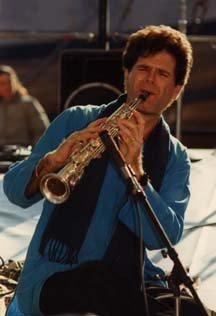
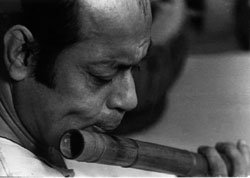
In Benares, Steve studied shenai with a local teacher and then traveled to Calcutta where he was invited to meet the Bengali bansuri master Sri Gour Goswami.
“We went to Hedwa in North Calcutta, passing through narrow lanes lined with sweet shops, tea stands and sari merchants. Bells were ringing from small neighborhood temples and the air was thick and pungent with everything from sandalwood incense to cow dung. We were directed to a doorway that led along a corridor into a small courtyard. A servant motioned to a room on the south end of the courtyard and we entered the stone compound.
Seated on the floor, in a circle, were six men all dressed in white. In the center of the circle was a robust middle-aged man, his feet tucked under his dhoti, his lips red from the betel-nut he was chewing. A cup of tea was at his side and a harmonium and flute case lay on the floor before him. This was the teacher I had heard so much about.
I was introduced in Bengali (although I learned later that these men spoke fluent English) and they proceeded to talk about me at length in a language I couldn’t understand. I stood there, grinning awkwardly, being discussed as if I were a specimen from Mars. Finally, the master looked at my flute case and said, “So, let me see your flute.” I took it out and gave it to him. He looked at it, shrugging his shoulders, “It’s not very good,” he said, “it’s not made right.” I started to say something but he continued, “Who did you learn from?” When I told him he let me know that I had learned from an insignificant person.
I was becoming annoyed at being so readily dismissed. I wanted to play for him and show him what I knew, but they continued to sip their tea, conversing endlessly in Bengali. Finally, they asked me to play a raga for them. I was very nervous by then but managed to play. When I finished, Gour Goswami said, “You have a good sense for this music, but you have not been taught properly.” He then took out his flute and played for me. The tone was deep, warm and velvety, utterly weightless. The raga unfolded and time stopped. It was breathtaking as the passages came faster and faster, ending in a flourish of cascading sound that reverberated through the stone room. And then it was over and everyone was once again drinking tea. I just sat there, stunned. I looked at him and stuttered, “May I come back?” He smiled and said, “Yes.”
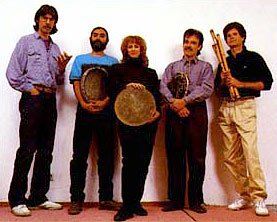
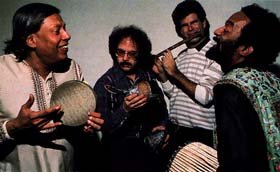
Returning to the U.S. he continued his study of Indian music with Pandit Raghunath Seth, and brought his elegant bansuri sound to American pop music, influencing a wide range of musicians, recording with Paul Simon, Richie Havens, Paul Winter, Jack DeJohnette, Glen Velez, and many others. Deepak Chopra, Krishna Das, Coleman Barks, Jai Uttal, Jerome Robbins, and Julie Taymor are among those who have sought out his virtuoso bamboo flute. He has composed for film, television, dance and theatre, and performed in concerts and festivals throughout the world, drawing from classical Indian, jazz and world music to create a distinctive signature sound.
His landmark world music recording, “Asian Journal,” and the unique “Wings and Shadows” have become cult favorites, and his acclaimed cd, “Luminous Ragas,” was named one of the top ten recordings of the year by Los Angeles Reader.
Describing his 1996 performance in Mumbai at the Sangeet Research Academy’s Indian Music and the West Seminar, SRA West Chairman, Arvind Parikh has said, “Steve Gorn’s concert was widely appreciated for its outstanding musicianship…. and has won him a host of admirers.” In 1998, Steve returned to India performing to enthusiastic audiences at The Nehru Center, NCPA, and the Dadar Matunga Music Circle in Mumbai.
REVIEWS

“An extraordinary flute recital by Steve Gorn from the USA”
– The Pioneer, Mumbai –
“Steve Gorn has adapted Indian Classical Music on the bansuri so nicely that one should feel proud of him.”
– Hari Prasad Chourasia –
“…an astonishing treatment of raga… Gorn went beyond the notes to reach a place where his instrument was more effective than the human voice.”
– Anand Bazar, Calcutta –
“Steve Gorn performed exquisitely and evocatively on the bamboo flute.”
– The New York Times –
“Steve Gorn plays with liquid grace. He is a master of sound-magic; may the world discover his gift.”
– Paul Winter –